
Registration
Please register free (for catering purposes) online here. Please register by August 21st.
We’ve started a group, which you can join by emailing Kenneth Forkert-Smith for a link.
Meet n Greet Monday
For those who wish to, we’ll meet at the Buyers’ Club (24 Hardman Street, L1 9AX) 7.30. There’s a big table booked for drinks / nibbles / small plates in the name of “Kenneth”.
Daily Schedules
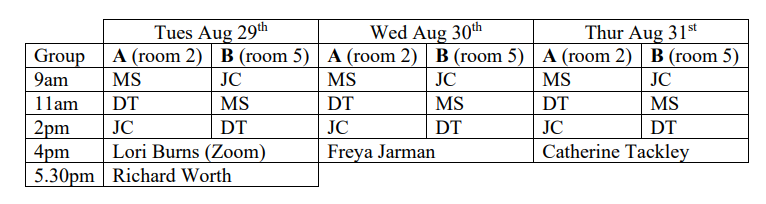
Due to building works in music facilities, teaching sessions take place in our Management School Seminar rooms 2 and 5. Meet in Room 2 at 9am on Tuesday. (Map here).
Our plenary sessions will take place in the Music Department “Hub”, 80 Bedford Street South.
Teaching Session Information and Resources
Due to unforseen circumstances, Lori Burns is unable to teach this year. We are grateful to John Covach (Rochester) for agreeing to teach in Lori’s place.
Mark Spicer, “Tonality and Form as Process in Pop and Rock Songs”
This workshop will explore how our understand of tonality and form in pop and rock songs is shaped by our experience of listening to recordings as they unfold in real time. We will begin with issues of tonality and then move on to form, discussing representative examples along the way. Students are asked to read the following articles in preparation:
Tonality
Mark Spicer, “Fragile, Emergent, and Absent Tonics in Pop and Rock Songs,” Music Theory Online, 23/2 (2017). https://mtosmt.org/issues/mto.17.23.2/mto.17.23.2.spicer.html
OPTIONAL:
Walter Everett, “Making Sense of Rock’s Tonal Systems,” Music Theory Online 10/4 (2004). https://www.mtosmt.org/issues/mto.04.10.4/mto.04.10.4.w_everett.html
Nicole Biamonte, “Triadic Modal and Pentatonic Patterns in Rock,” Music Theory Spectrum, 32/2 (2010): 95–110. https://www.academia.edu/1435121/Triadic_Modal_and_Pentatonic_Patterns_in_Rock_Music
I also invite you to have a go at making a harmonic analysis of the following five songs (using functional Roman numerals where appropriate), all of which are readily available to listen to for free at Spotify, YouTube, and other streaming audio sites. As with most recorded popular music of the past seventy years, the recordings themselves are the true “scores” and any published sheet music should be viewed with caution. Nevertheless, you can find sheet music versions of these songs at musicnotes.com and other sites (if you use the Chrome browser, you can preview the pages onscreen at musicnotes.com without actually purchasing the music). You can also search the web for lyrics and chord symbols to these songs, but again, don’t assume that everything you find posted online is 100% accurate.
- The Stylistics, “You Are Everything” (1971)
- Luther Vandross, “Never Too Much” (1981) [HINT: Compare this song to Michael Jackson’s “Rock With You” (1979), which I discuss in my MTO article.]
- The B-52’s, “Love Shack” (1989)
- Gotye, “Somebody That I Used to Know” (2011)
- The Weeknd, “Blinding Lights” (2019)
Form
Mark Spicer, “(Ac)cumulative Form in Pop-Rock Music.” Twentieth-Century Music 1/1 (2004): 29–64. https://hcommons.org/deposits/item/hc:27479/
OPTIONAL:
Brad Osborn, “Subverting the Verse–Chorus Paradigm: Terminally Climactic Forms in Recent Rock Music,” Music Theory Spectrum 35/1 (2013): 23–47.https://hcommons.org/deposits/item/hc:20133/
Megan Lavengood, “‘Oops … I Did It Again’: The Complement Chorus in Britney Spears, The Backstreet Boys, and *NSYNC,” SMT-V 7.6 (2021).
http://www.smt-v.org/archives/volume7.html#oops-i-did-it-again-the-complement-chorus-in-britney-spears-the-backstreet-boys-and-nsync
Finally, if you have time, listen carefully to the following five songs—one each from the 1970s, 1980s, 1990s, 2000s, and 2020s—and come prepared to make some preliminary observations as to why these songs qualify as examples of accumulative or cumulative form.
- Peter Gabriel, “Solsbury Hill” (1977)
- New Order, “The Perfect Kiss” (1985)
[Compare the shorter (4:49) version of this song, as featured on the Low-Life album and available on Spotify, with the 10-minute-plus “extended” mix that one can hear—and watch as it unfolds—in the official music video for “The Perfect Kiss,” directed by the late, great Jonathan Demme and available on YouTube.] - Björk, “Hyperballad” (1995)
- Coldplay, “Viva la Vida” (2008)
- Tears for Fears, “No Small Thing” (2022)
David Temperley, “Theory and Analysis of Rock Music”
This workshop will explore aspects of rock music—loosely defined to include a broad range of late-20th-century popular styles. We will touch on a number of topics, but a recurring theme will be the ways that local details (of rhythm, harmony, melody, texture, etc.) relate to large-scale form and expressive meaning. Our text will be my 2018 book The Musical Language of Rock. The book is available at amazon.co.uk for £22.99. The musical examples can be heard at https://global.oup.com/us/companion.websites/9780190870522/audio/ . I encourage you to read as much of the book as you can, but certain chapters and sections will be especially relevant. Below I list the main topics for each of the three days and the sections of the book that should be read.
Tue Aug. 29: Rhythm and meter (read chapter 4)
Wed Aug. 30: Topics in melody/harmony, emotion, and form (read section 5.3, chapter 7, sections 8.1 and 8.3, and pp. 167-71)
Thurs Aug. 31: Formal strategies (read chapter 9)
A few notes on other chapters: Chapter 1 explains my understanding of the term “rock” and the statistical, corpus-based approach that informs much of the book. Chapters 2 (on scale and key) and 3 (on harmony) are not essential for the workshop, but a couple of concepts will be useful: 1) I present what I call the “supermode,” which is a scale consisting of all twelve chromatic scale-degrees except b2 and #4; this represents the normal pitch material of rock. 2) The distinction between major and minor modes, while applicable to rock, is much more of a continuum than it is in classical music, with mixtures of major and minor being very common—due to the use of Dorian and Mixolydian modes, the combination of minor-mode melodies with major-mode harmonies, and harmonic progressions that combine major tonic harmony with “flat-side” harmonies like bVII, bIII, and bVI.
David has provided a worksheet of questions for students to work through. These are located on a pdf file here.
John Covach, “Stratification, Texture, and Position in Rock Music”
This workshop will explore issues of texture: What kinds of texture do we find in rock? Do the elements in these textures always align in the ways we expect them to classical music? When textures become complex, where is our focus as a listener and/or as a performer? How can we theorize these things and employ such ideas in analysis?
In the first class we’ll outline and explore these questions. I’m hoping you’ll be able to read Prof. Temperley’s article and view my video. It would be great if you could also read my “Analyzing Texture in Rock Music” chapter as well. In the second and third class we will continue to explore these issues in more detail. I’ll assign listening for each of these classes as we go and the required and optional reading will provide us with a wide variety of music for discussion and analysis.
Required Reading
Davy Temperley, “The Melodic-Harmonic Divorce in Rock”: http://davidtemperley.com/wp-content/uploads/2015/11/temperley-pm07.pdf
John Covach, “Textural Stratification in Rock Music” (brief video): https://www.academia.edu/30188547/Textural_Stratification_in_Rock_Music_2014_a_brief_video
John Covach, “Analyzing Texture in Rock Music: Stratification, Coordination, Position, and Perspective”: https://www.academia.edu/37864733/_Analyzing_Texture_in_Rock_Music_Stratification_Coordination_Position_and_Perspective_in_Pop_weiter_denken_Neue_Anst%C3%B6%C3%9Fe_aus_Jazz_Studies_Philosophie_Musiktheorie_und_Geschichte_Beitr%C3%A4ge_zur_Popularmusikforschung_44_ed_Ralf_von_Appen_and_Andr%C3%A9_Doehring_Transcript_Verlag_2018_53_72
Optional Reading
Drew Nobile, “Counterpoint in Rock Music: Unpacking the ‘Melodic-Harmonic Divorce’”: https://www.academia.edu/6804222/Counterpoint_in_Rock_Music_Unpacking_the_Melodic_Harmonic_Divorce_
Trevor DeClercq, “The Harmonic-Bass Divorce in Rock”: https://www.midside.com/publications/declercq_2019_spectrum.pdf
John Covach, “Yes, ‘Close to the Edge,’ and the Boundaries of Rock”: https://www.academia.edu/7634192/_Yes_Close_to_the_Edge_and_the_Boundaries_of_Rock_in_John_Covach_and_Graeme_Boone_eds_Understanding_Rock_Oxford_University_Press_1997_3_31_To_read_this_article_go_to_http_www_lipscomb_umn_edu_rock_docs_Covach1997_Yes_pdf
John Covach, “The Performer’s Experience: Positional Listening and Positional Analysis”: https://www.academia.edu/43798126/_The_Performer_s_Experience_Positional_Listening_and_Positional_Analysis_in_G_Borio_G_Gioriani_A_Cecchi_and_M_Lutzu_eds_Investigating_Music_Performance_Theoretical_Models_and_Intersections_Routledge_2020_56_68
Plenary Titles
Catherine Tackley (University of Liverpool), “The Music of the British Dance Bands”
Freya Jarman (University of Liverpool), “Approaching Music as Sound: spectrograms as an analytical tool”
Lori Burns (University of Ottawa), “Sharing Sonic Space in Metal Duets: Floor Jansen’s Vocal Collaborations”
Richard Worth (University of Liverpool), “Tonality, WTF?“
1 thought on “Popular Music Summer School Information”
Comments are closed.